Free-body diagrams, Mohr's circle, Bernoulli, steam tables, the Rankine cycle, heat exchangers, the Goodman line. Each topic fits on one page: what to sketch first, which formula applies, where to find it in the FE Reference Handbook, and the math worked line by line with units carried through. 89 illustrated pages.
🔒 Secure checkout · PDF by email · 30-day guarantee
One topic per page: a drawing that shows you the setup, and boxes with what you need to know:


Swipe to see more →
These are real pages from the book. The table of contents is the full one: 13 parts and 84 topics.
You've read the section on beam reactions three times. You close your notes...
...and you're no longer sure how many reactions a pin gives or which sign each one gets. It was just lines of text.

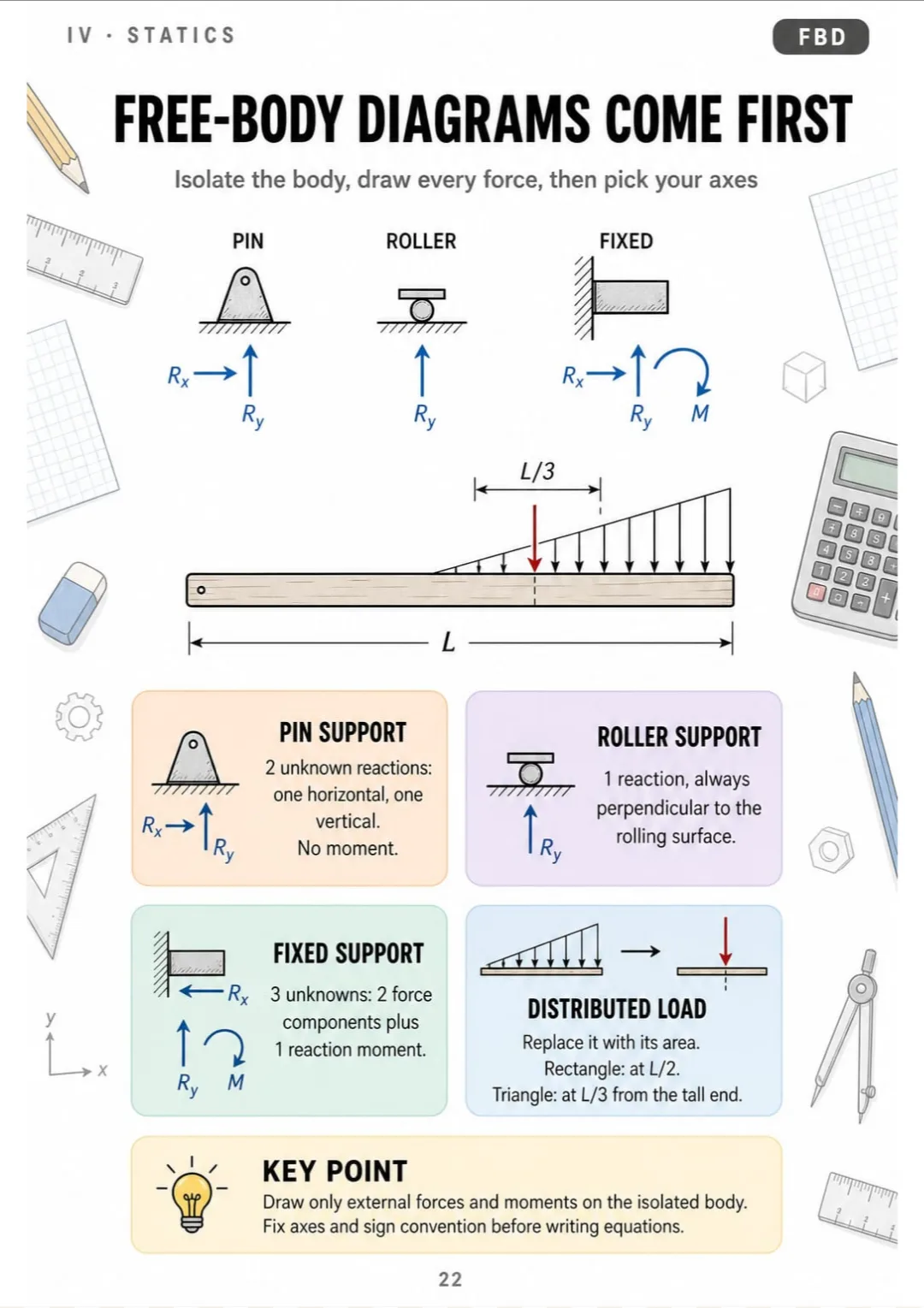
Here supports are one drawn page: the pin with its two reactions, the roller with one, the fixed support with two forces and a moment, and the free-body diagram drawn before a single equation.
And on the pages next to it, every topic has its own: the free-body diagram, beam deflection, Bernoulli, the Rankine cycle and the Goodman line.
First you understand why it's set up that way. Then the order comes back to you on its own.

Exam basics, math and economics, electricity, statics, dynamics, mechanics of materials, materials, fluids, thermodynamics, heat transfer, controls, mechanical design and test day: 89 pages, all drawn
Picture this:
Instead of rereading half a page about Mohr's circle without being able to see it...
...you open the page and find the circle built in four drawings, with the sign convention, the center, the radius and 2θ marked right on it.

And statics, Bernoulli, the steam tables, the Rankine cycle and heat exchangers turn into drawings and tables you can read at a glance.
You stop repeating and start understanding.
That's exactly what The FE Mechanical Exam Sketchbook does. It's not “just another review manual.” It's 13 parts and 84 drawn topics, and at the end the most frequent mix-ups side by side and a test day checklist. Because what your brain sees in order, it remembers.
Because what your brain sees organized, it remembers.
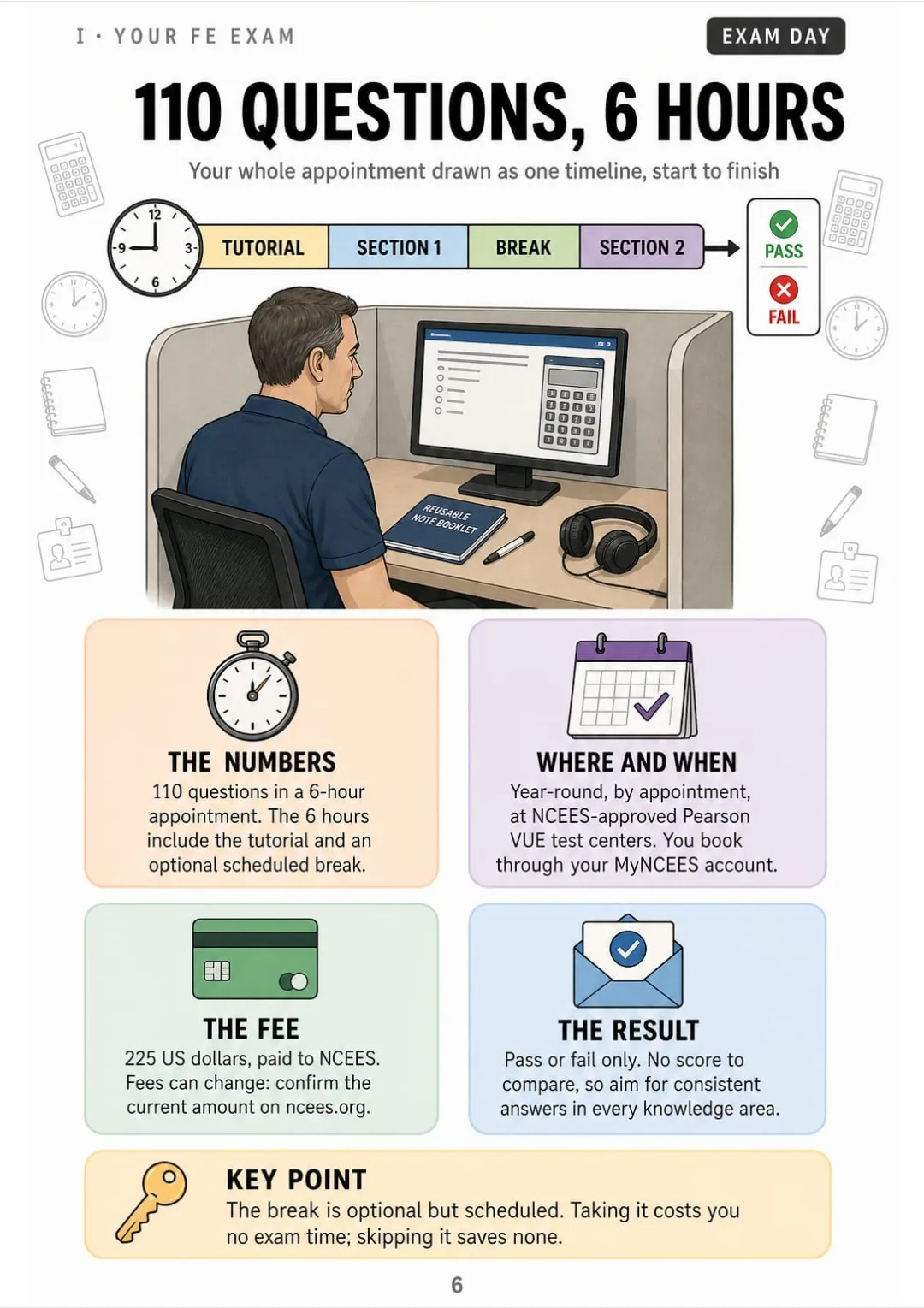
How the CBT works (110 questions, 6 hours), how to find any formula in the FE Reference Handbook, and the SI and US customary units that trip you up.
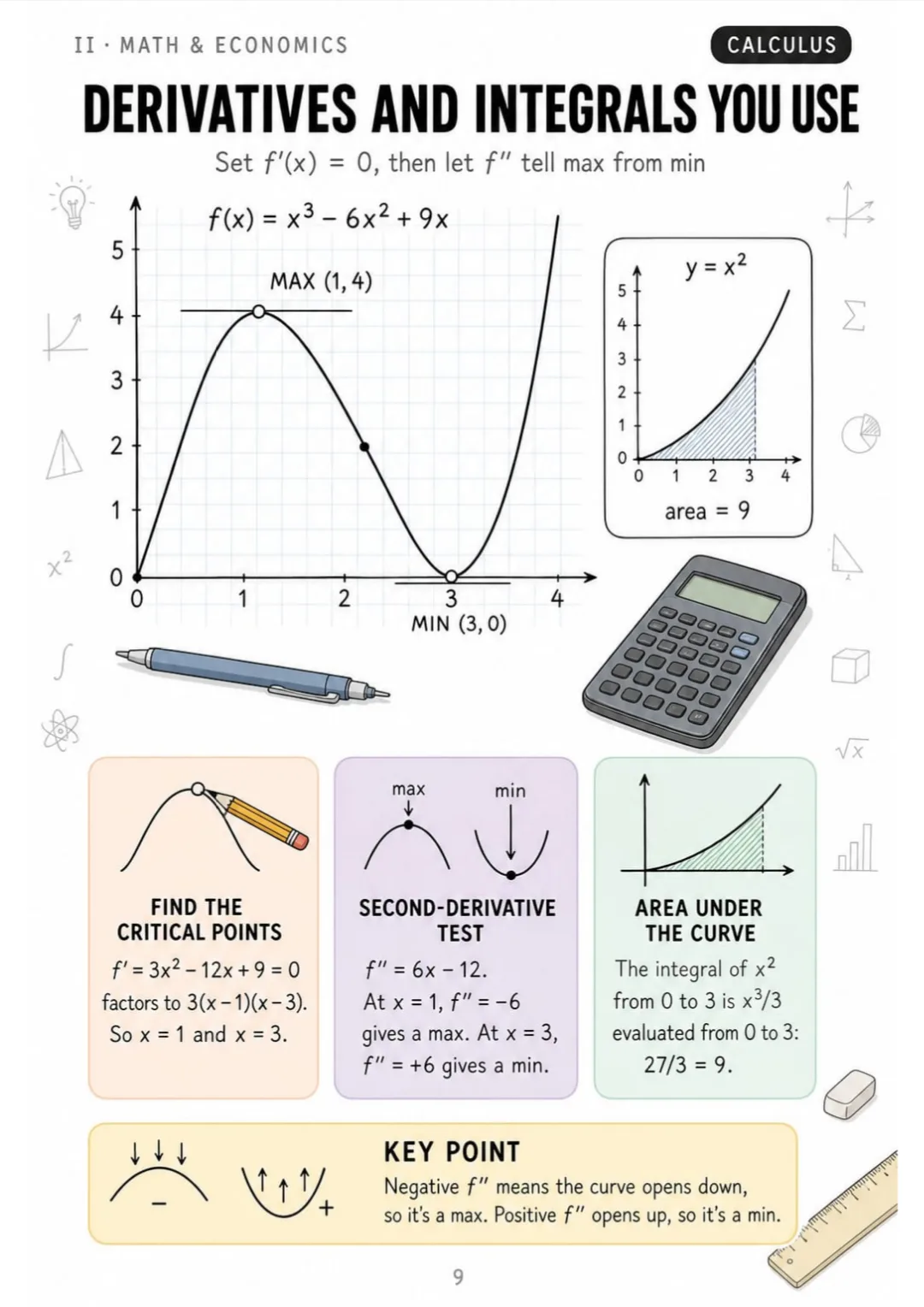
Derivatives and integrals, differential equations and Laplace, vectors and matrices, Newton's method, the normal distribution, regression, ethics, time value of money and break-even.
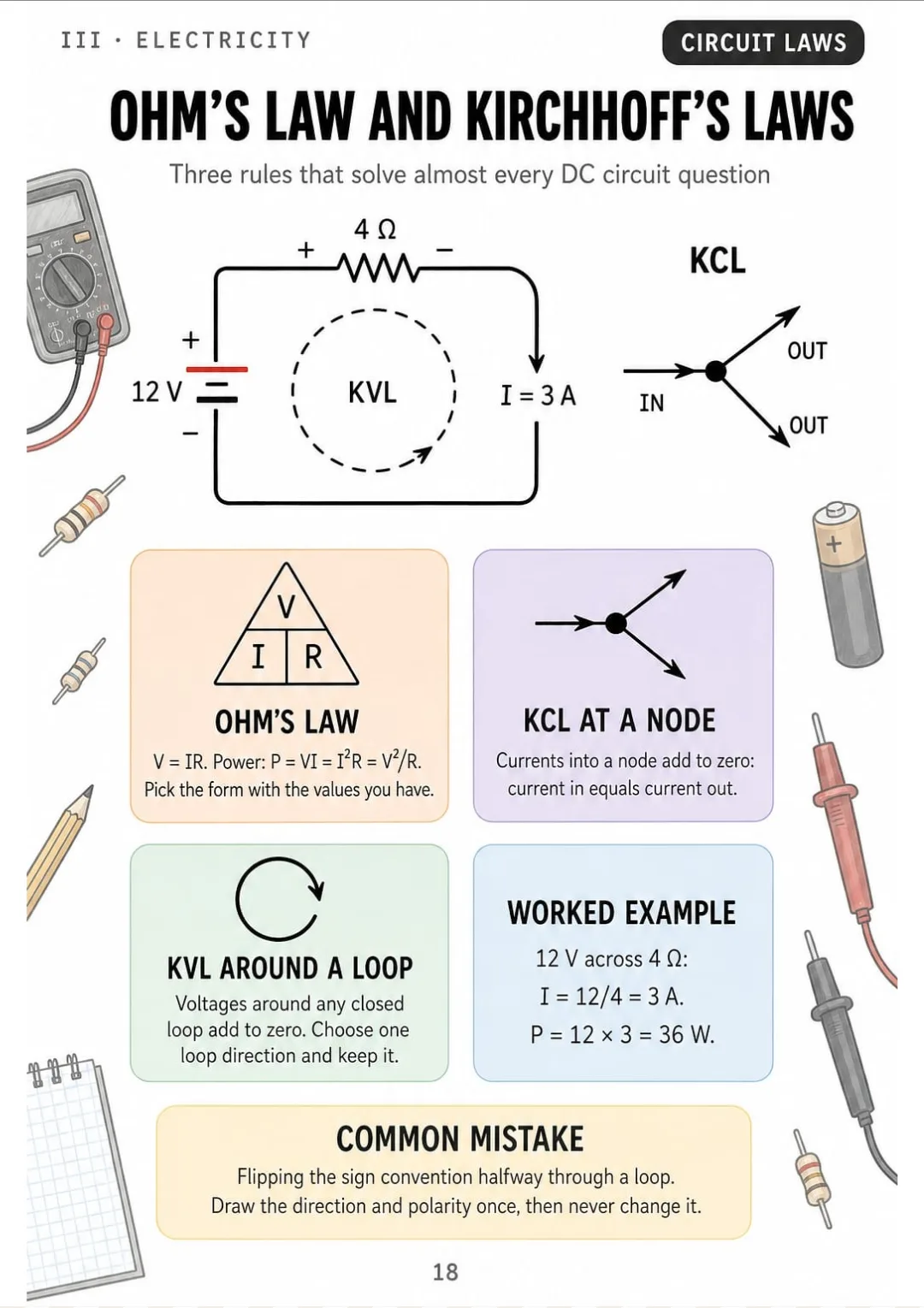
Ohm's and Kirchhoff's laws, series and parallel circuits, AC circuits with resistors, capacitors and inductors, and motors and generators.
Resultants and free-body diagrams, equilibrium, trusses by joints and by sections, frames and machines, centroids and moments of inertia, and static friction.
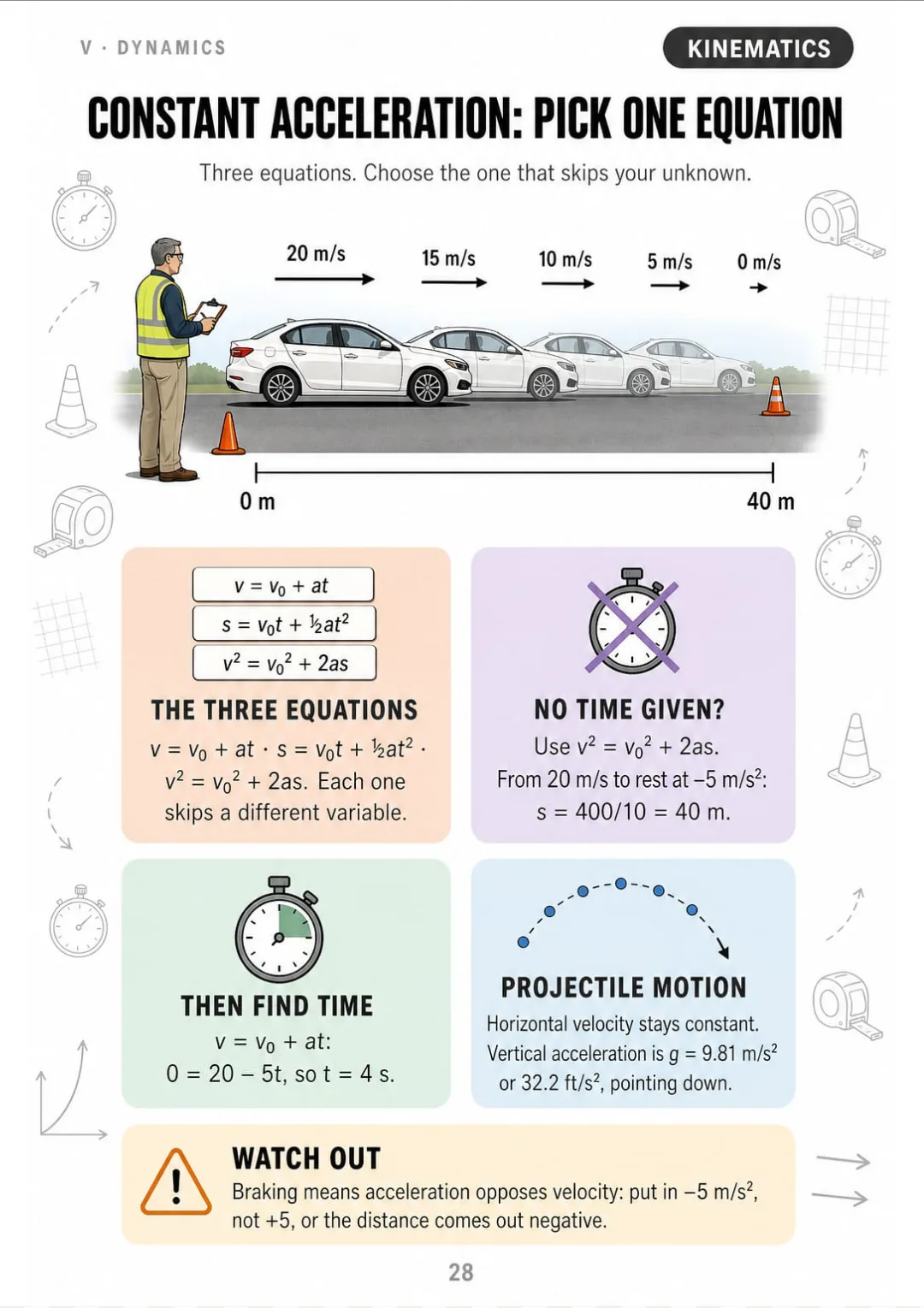
Constant acceleration, Newton's second law with friction, work-energy, impulse and momentum, rigid-body rotation and mechanisms, and free and forced vibration.
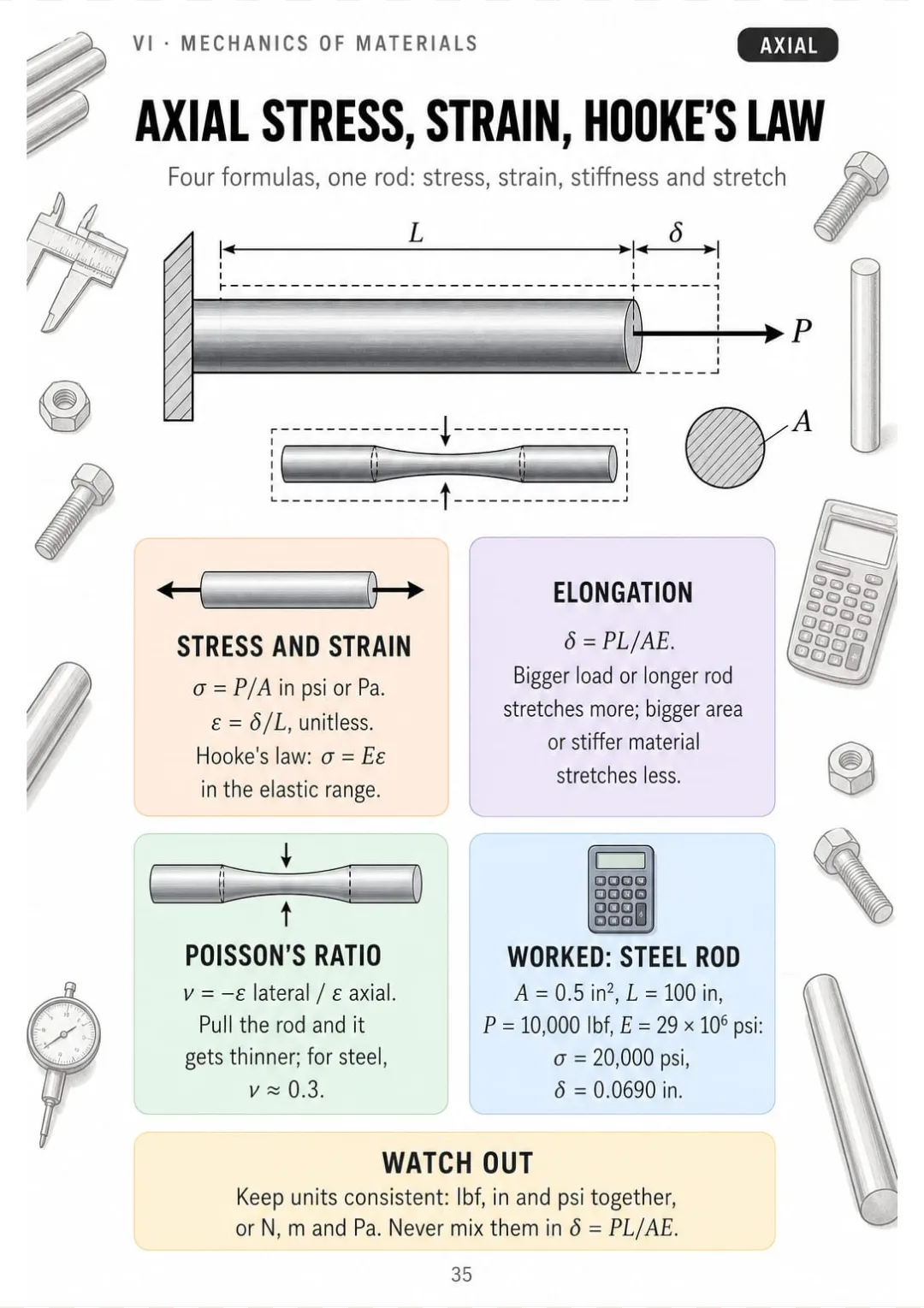
Axial stress and Hooke's law, shear and moment diagrams, My/I, Tr/J, thermal stress, Mohr's circle, combined loading, beam deflection and Euler buckling.
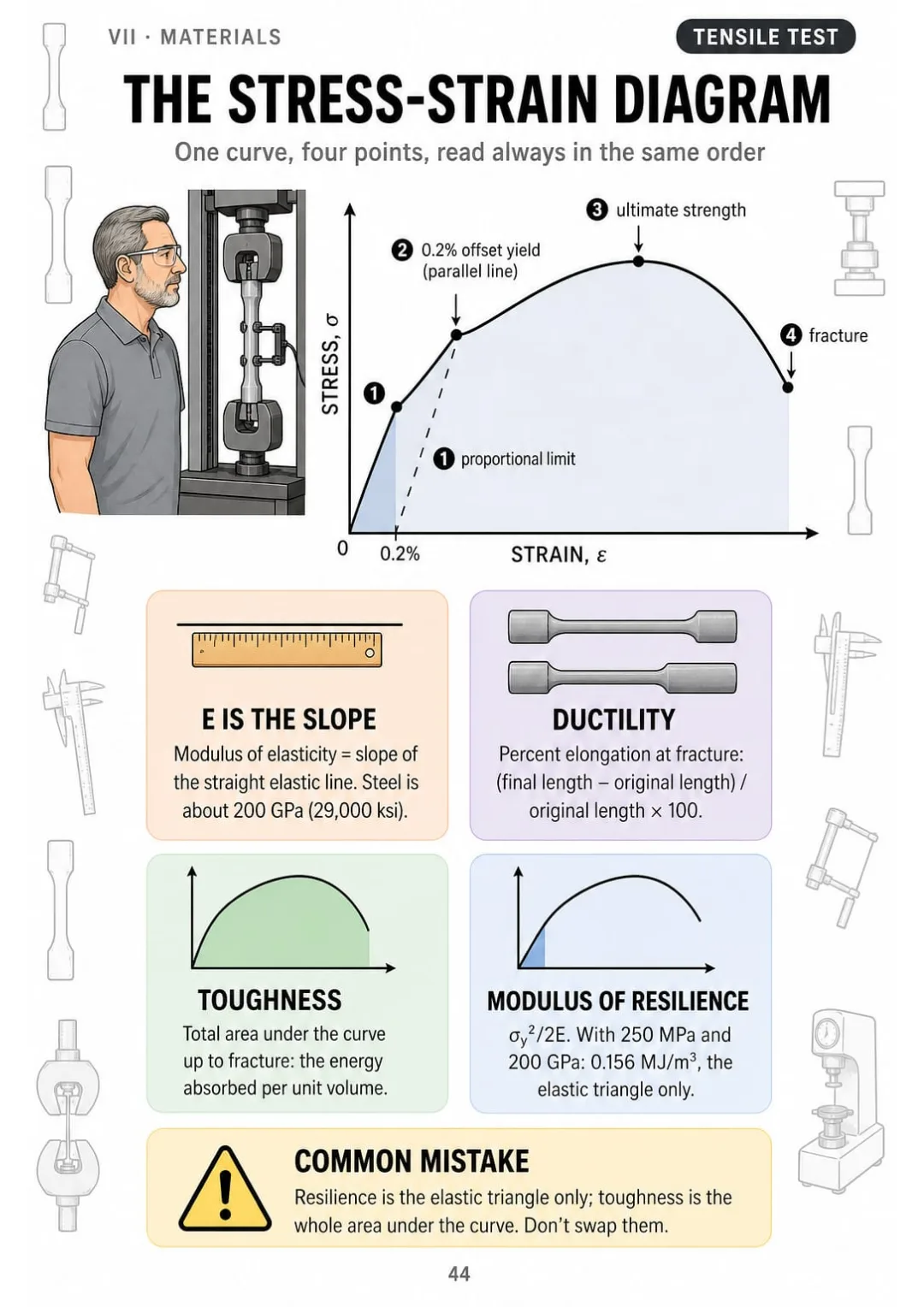
The stress-strain diagram, ferrous and nonferrous metals, the iron-carbon diagram, heat treating, manufacturing processes, corrosion, and fatigue, creep and fracture.
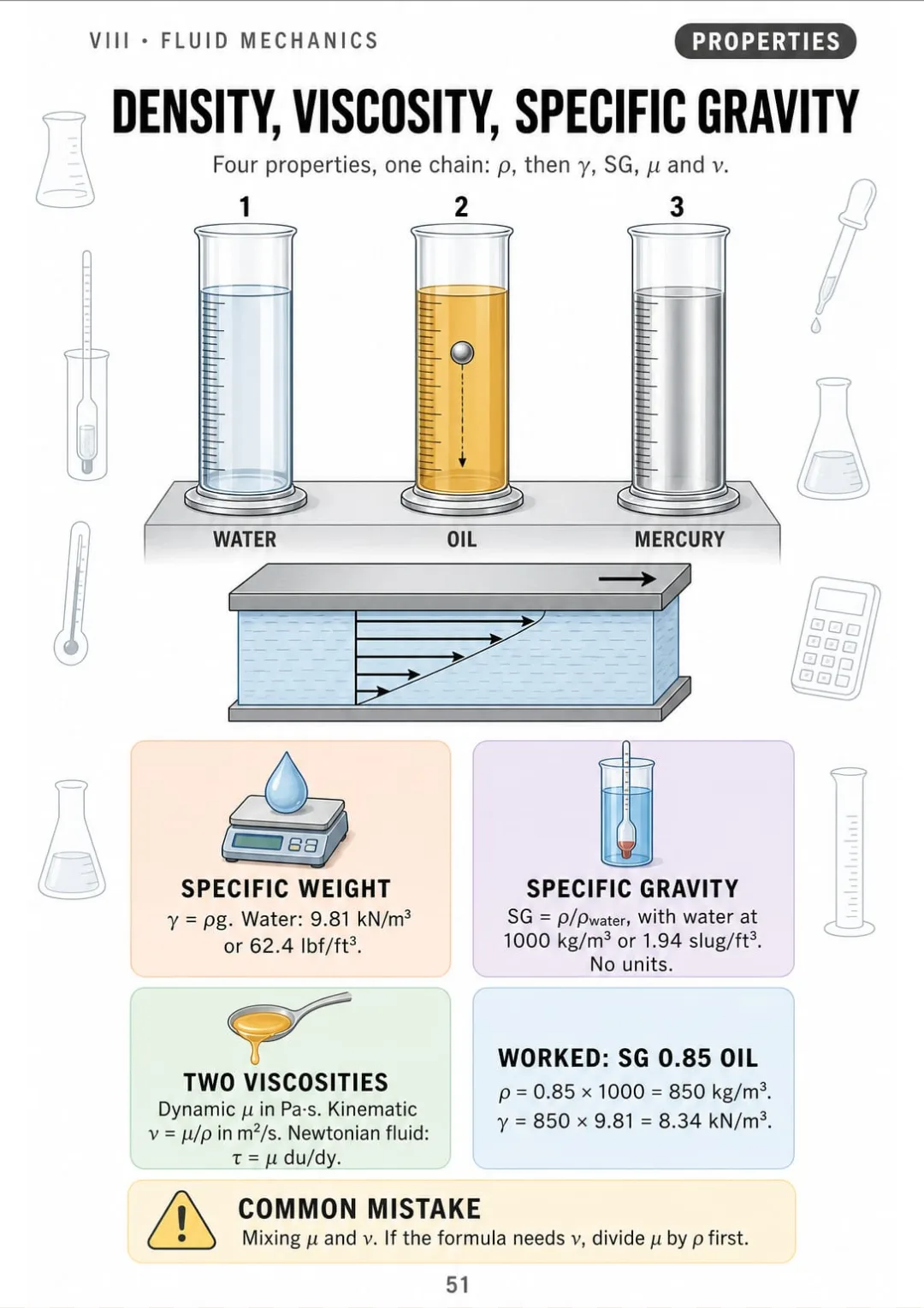
Density and viscosity, manometers, continuity and Bernoulli, jet forces, Reynolds number and Darcy friction, drag and lift, Mach number, pumps and the affinity laws.
Ideal gases and steam tables, the first and second laws, turbines and nozzles, the Rankine, Otto, Diesel and Brayton cycles, refrigeration, the psychrometric chart and combustion.
Conduction and thermal resistance, convection, radiation, lumped capacitance, and heat exchangers with LMTD and effectiveness.
Sensors and transducers, block diagrams and feedback, first- and second-order system response, and measurement uncertainty.
von Mises vs Tresca, the Goodman line, springs, thin-walled pressure vessels, bearings, gears and belts, bolted and welded joints, limits and fits, and GD&T symbols.
The most frequent mix-ups side by side and a checklist for test day.
At the end of the book: The most frequent mix-ups side by side and a test day checklist.

40 loaded parts and thermodynamic cycles to draw and solve on your own, each with a fully worked answer so you can check every step.

Printable cards for quick review: the term or formula on the front, and its variables, units and a small sketch on the back.
📄 This is a digital PDF book sent to your email: nothing is printed or shipped.
PDF by email: The FE Mechanical Exam Sketchbook reaches your inbox as a PDF, and the two free books come by email too. One-time payment, no installments or hidden costs.
Statics, mechanics of materials, fluids and thermo, one topic per page, to review between classes while it's all still fresh.
A full review of the 14 knowledge areas in one fixed order, and at the end the most frequent mix-ups side by side and a test day checklist.
Years after your last thermo class, a drawn review that fits into nights and weekends: what to sketch first, which formula applies and where to find it in the Handbook.
📄 This is a digital PDF book sent to your email: nothing is printed or shipped.
30-day guarantee: tell us what didn't work and we'll refund 100%.
You have 30 days to try The FE Mechanical Exam Sketchbook and the two bonus books. If it doesn't work for you, email us, tell us what didn't work and we'll refund 100% of what you paid. One-time payment, no subscriptions, no surprises.
After your purchase you'll get an email with The FE Mechanical Exam Sketchbook as a high-resolution PDF, to read on your phone or print. The two bonus books, FE Mechanical Free-Body and Cycle Workbook and 250 Formulas and Terms on Cards, also come by email. Everything is sent to the email address you enter at checkout.
A one-time payment of $27. No installments and no subscription. The extras offered at checkout are optional: you're only charged for them if you add them.
For senior mechanical engineering students, recent grads preparing for the FE Mechanical, and working engineers who never took it or are retaking it and want a visual review. Check the table of contents above to see every topic.
On the NCEES FE Mechanical CBT exam specification and the NCEES FE Reference Handbook. Every worked example carries its units on every line, so you can check each step yourself. Each page points to where its formula lives in the Handbook without reproducing it. NCEES updates both documents, so check ncees.org for the current versions before your test date.
No. It's an independent study guide, not affiliated with or endorsed by NCEES or any state licensing board. On exam day you work with the official FE Reference Handbook.
No, it works alongside them. The Handbook gives you every formula but not which one to use. A prep course gives you hours of video. This book gives you one drawn page per topic: what to sketch first, which formula applies, where it lives in the Handbook, and the math worked line by line with units on every line. It doesn't replace your degree, the Handbook or a prep course, and it doesn't promise a passing result.
No. Every problem is original, written for this book and labeled exam-style. They're for practice, not real exam questions.
Yes. The book and the two bonus books are PDFs you can print at home or at a print shop, including the formula cards.
30-day guarantee: tell us what didn't work and we'll refund 100%.
You don't have to reread the same page hoping it sticks this time.
You don't have to memorize formulas you can't picture.
And you definitely don't have to walk into the exam without knowing where to start.
There's an easier way. And it's one click away. Now it's your turn.
One-time payment: US$ 27 · Guarantee: 30 days · PDF by email
YES, I WANT THE FE MECHANICAL EXAM SKETCHBOOK FOR US$ 27📄 This is a digital PDF book sent to your email: nothing is printed or shipped.